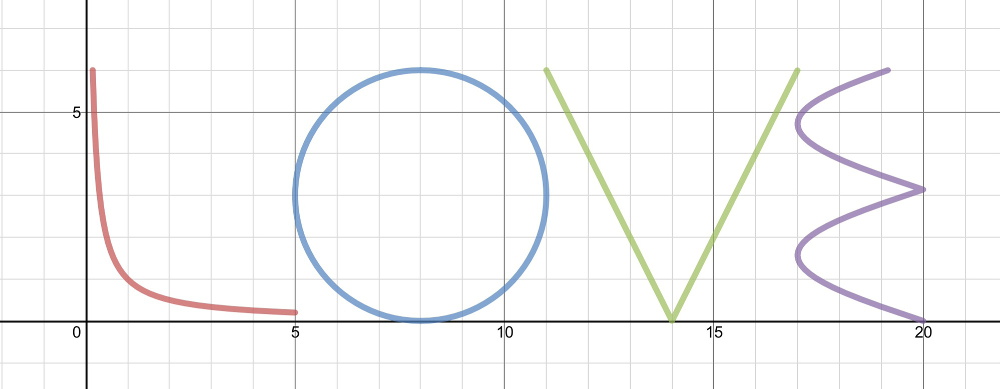
All you need is …

LOVE

Here’s a challenge for you:

Fire up your favourite graph plotter (mine is Desmos) and see if you can reduce LOVE to four equations.

You’ll need to think about the domain and range, and a knowledge of the modulus function helps, making this a good exercise for A-Level students.

*** Spoiler Alert ***

You can see the four individual functions >>here<< (but you’ll still need to transform them into position) which I first stumbled across on this great collection of resources.

Posted in Algebra, Teaching Tips | Tagged | Comments closed

Consequences

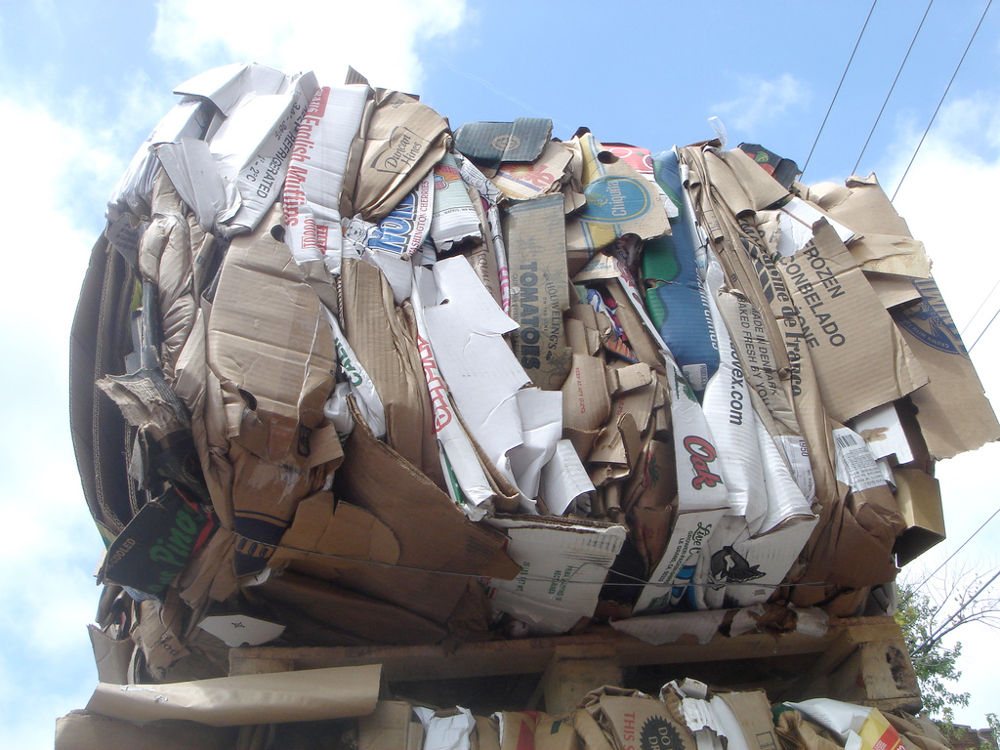
Ex Boxes

Ex Boxes – Photo by Ryan Dickey. License CC 2.0

When I were a lad things were different.

When I were a lad, an eye pad was a patch taped onto the glasses of the kid who suffered from “lazy eye”; a wii was, well, a wee and an ex-box was all that remained of your cereal packet after your sugar coated breakfast treat.

When I was a lad, we had to make our own entertainment. We used to play a game called consequences.

We’d all sit around a table with a strip of paper, write a boy’s name on the top, fold it over and pass it on to the next person, who then wrote a girl’s name, folded it over and passed it on, and so on, until a short and witty (and probably rude) short story emerged. (Wikepedia explains it here so much better than I could ever hope to do.) Hours of endless fun!

Anyway, I was reminded of this game when a (much younger) colleague came back from a Further Maths Inset course and asked us all to write the equation of a function at the top of a piece of paper and pass it on. The recipient then had to sketch the graph of the given function, fold the top of the paper and pass it on again to a new recipient who then had to write the equation of the function from looking at the graph. Then, and only then, was the original function revealed to (hopefully) be the same as function written at the end.  What a brilliant adaptation of a game I had last played all those years ago.

I played the game with my Upper Sixth A-Level students who soon grasped the idea and got into the game, one pupil deciding it was great fun to give his neighbour – his friend – some pretty complex functions to sketch. (With friends like that …)

Recognising a great idea when I saw it, I stole the concept and adapted it to my own needs.  My year 10s had been working on y = mx + c – the equation of a straight line – and I realised that this would be a great consolidation exercise:

Write the equation of a straight line > Make a table of points > Plot the graph > Find the gradient and y intercept > Write down the equation of the straight line.

It worked really well, allowing the pupils to practise what we had learnt in the week and quickly flagging up any problem areas.  I created a worksheet with the stages laid out to help with the flow of the stages – you can grab a copy of my worksheet here – I think for this task and age group having this bit of structure to the task was useful.  There was genuine excitement at the “unraveling” to see if the final equation agreed with the original.  In most cases it did, and when it didn’t it threw up a great opportunity for the class to discuss where the mistake had been made.

So, perhaps not quite as much fun as discovering that “Morbid Malcolm met Happy Hilary at the school disco …”, but a great idea that works well in the classroom.

I’m off to see what other Victorian parlour games I can adapt for use in the classroom.  Wink murder, anyone?

Posted in Games, Teaching Tips | Comments closed

They think its all over …

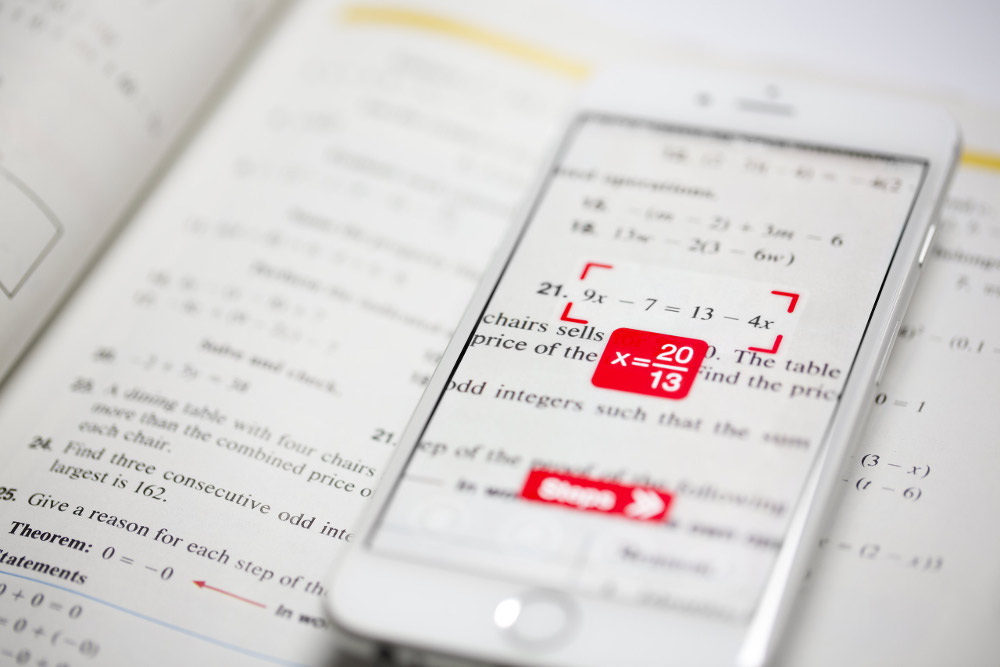
photoMath app

My Year Nines bundled into my classroom this morning with even more excitement than normal.  I attributed this extra energy to a combination of the high winds as the remnants of Hurricane Gonzalo battered our sceptered isle and the imminent prospect of the half term holiday.

But I was wrong.

One of the students had discovered “the end of maths.” One of the students had discovered Photomath.

With great fanfare and pride, he whipped out his iPhone and declared that his new app could solve maths questions.

Intrigued, I abandoned my carefully crafted lesson plan, fired up “airserver” so that we could see his device projected onto the interactive whiteboard, grabbed a text book, flicked through to an algebra question and challenged his phone to solve:

3x + 2 =17

In moments, the phone, much to the delight of the class, was telling me that

x = 5

Impressive.

We tried some other questions, and each time it came up trumps. Until it was presented with:

(x+2)(x+3) =0

It seems it can’t (for now at least) solve quadratics.

But its still a pretty neat bit of kit. And does it spell the end of maths as we know it? Probably not.  I’m of an age such that I was amongst the last to take my ‘O’-Levels without being able to use a calculator in any papers. All the advent of the calculator did was free students from the shackles of mechanical computations (and log tables) allowing them to spend more time tackling harder problems. So as I pointed out to my pupils, much to their disappointment, this wonderful app probably just means that their maths will get harder.  Which is a good thing, although I’m not sure that they all agreed with me on that.

Will I allow my pupils to use the app? Absolutely.  As a means for them to check their work it’s unrivaled.  Students are far more engaged when they are in control of their learning and this app gives them instant feedback.  And I’ve learnt over the last few years that they are far more likely to “listen” to an electronic device, rather than teacher, telling them that they are right or wrong.

Also, the step by step solution to a problem given by the app is great at guiding a student through all the stages of answering a question: the app does what too many students don’t do – it shows it’s working out.

Oh, and the app does occasionally get things wrong.  For example, when a question number is close to the question itself, if you are not careful in lining up the camera you can easily include the question number as part of the question.  I’m sure the developers will be keen to rectify any bugs but, as a teacher, I’d be quite happy for them to leave them in. When a pupil gets a different answer from the app it leads to some great discussion points and debate as to who is right, them or the computer, and it really forces the pupil to think about the maths behind their answer.

So, much to the chagrin of my Years 9s, its not all over for maths, but they have now got a great new tool for exploring the subject.

You can download the app from the app store (its free!) and you can find out more from the developers website:

PhotoMath Logo


Posted in Algebra, Numeracy, Teaching Tips | Comments closed

A Good Question

If Tan x = 3/4 what does sin x =?So half my Year Eleven’s are missing, out on a Geography field trip. No point starting anything new, time to whip out some trusty revision material – “20 Homework Quickies” if I remember correctly. 20 short questions on a range of GCSE topics: 3x + 4 = 5 x – 2,  write 0.00012345 in Standard Form etc.

All good stuff, helping the pupils re-visit topics they may not have seen for many months, and telling me what areas they have collectively forgotten about.

But question number 4 was a real gem. Question number 4 was:

If tan x = 3/4 what is sin x?

A seemingly innocuous little question, reach for the calculator, type in the numbers and out pops the answer.

STOP! Put down the calculator. Let’s think about the question:

“When do we use tan?” Cue inevitable jokes about sun tan and fake tan.

“When do we use tan?”

“Dunno”

“When do we use tan?” Beginning to sound like a broken record, but I’m not giving up.

“Right angled triangles”

“Excellent.  And what else do we do with right angled triangles and tan?”

“Sin” (to rhyme with gin.)

“We pronounce it ‘sign.’ And what else?”

“Cos”

“Oooh, I went there for my holidays, and got a nice tan” says the class comedian. Never.

“So we’ve got a right angled triangle, Tan, Sine and Cos.  What do we do next?”

“Sohcahtoa” comes a random cry from the back of the class.

“Label the sides. What are we going to call them?”

“Sohcahtoa”

“O, A and H”

“Brilliant. And which is which?” (At this point you can have a little diversion into A level Statistics. How many different ways can you label the three sides of a triangle with O, A & H? The probability is quite high that your class with have found them all before you can work out how many there are.)

You agree on which of the six different permutations is correct.

“Sohcahtoa”

You begin to think that there is an echo in the classroom.

“So what is the purpose of ‘SOHCAHTOA’, other than a phrase to be shouted out as you know it has something to do with triangles?”

” Sin equals O over H, Cos equals A over H, Tan equals O over A”

You console yourself with the thought that a least one pupil will pass this summer.

“And what else helps us with right angled triangles?”

“Sohcatoa”

“The angles in a triangle add up to 1800

“Scalene”

“But what – or who – else helps us when solving right angled triangle problems? Think of that Greek bloke.”

“Pythagoras”

“Excellent. What is Pythagoras Theorem?”

“a2 + b2 = c2

“Brilliant. So can we work out the hypotenuse?”

“If its the hypotenuse, why do we call it c?”

“Just work it out”

“5”

“And sin x is …?”

“O over H”

“And O is what? H is what? So, the answer to our question, what is sin x is …”

We get there in the end. Such a simple little question, but so much maths came out of it.

I bet they didn’t have that much fun counting cars on the geography field trip.
Posted in Geometry | Tagged | Comments closed

Maths Fail #4

Maths Fail #4Is it a numeracy fail or a literacy fail?

Yes 43%

No 57%

Posted in Maths Fail | Tagged | Comments closed