Percentages

Percentages

Percentages – Its all in the name: Per as in ‘out of’ and cent as in ‘century’ ‘dollars (or Euros) and cents’ ‘Centurion’ and ‘hundred’ in French. Percent means: ‘out of 100’

So to turn a percentage into a fraction, just shove it over one hundred:

58% = 58100

… but don’t forget to CANCEL DOWN the fraction, to become 2950. Easy!

Percentages to decimals is just as easy – remember what percent means? Yep, out of one hundred, so simply divide your percent by 100 to convert it into a decimal:

58% ÷ 100 = 0.58

Going the other way is just as easy – to turn a decimal into a percentage simply multiply a decimal by 100:

0.27 x 100 = 27%

Turning a fraction into a percentage can be tough, but remember – percent means out of 100, so just ‘cancel up’ the fraction until its out of 100 and your done:

1320 We need to make the bottom number 100 so: multiply the bottom by 5 to turn it into 100, and then multiply the top by 5 as well (“whatever we do to the bottom, we do to the top”)to give:

1320 = 65100 = 65%

Easy! Follow these simple steps and you, too, will soon be getting 100%!

If you want to find out how to find the percentage of a number – e.g. what is 65% of 180 – you need to read this.

Posted in Numeracy | Tagged , , | Comments closed

Vulgar Fractions

Vulgar Fraction

Pick up any dictionary and you will find ‘Vulgar’ defined along the lines of:

  1. Lacking sophistication or good taste; unrefined
  2. indecent; obscene; lewd

… and I’ve often wondered what the poor old fraction has done to deserve such a reputation.

I have visions of unruly fractions, burping and belching and generally terrorising the more gentle and sophisticated numbers.  I have an image of a gang of fractions, probably with a top heavy fraction like 145 as the gang leader, nipping behind the bike shed for an illicit smoke.  I picture some mutton-chopped Victorian mathematician so incensed by the decadent form of these fractions that he describes them as “vulgar little numbers”.


But, alas, the story of the vulgar fraction is much less colourful.  The vulgar in this context is:

  • common

and our vulgar fractions are nothing more than common fractions – fractions whose top number* and bottom number* are both integers (whole numbers.)

Although the average schoolboy (or girl) may not agree, fractions are actually pretty useful things and actually make maths a whole lot easier – when we encounter the delights of (harder) algebra, using fractions makes life much, much more simple than dealing with decimals.  So even if they are little vulgar and swear and curse a little, you’ve got to love vulgar fractions.

A Maths Teacher

*I much prefer to use the words “top number” and “bottom number” than numerator and denominator – why confuse things further with fancy words that are easily forgotten.

Posted in Numeracy | Tagged | Comments closed

Number 1 – Prime or Not

The Number 1 - prime or not?

The Number 1 – is it a prime number?

So – we normally say, a prime number is a number that can only be divided by itself and 1. A good working definition that most children know, understand and readily accept. But …

… but 1 is not a prime number.

Why? Well, the true definition of a prime number is “a number that has 2, and exactly 2, factors”

For example, the factors of 13 are: 1 and 13, the factors of 7: 1 and 7, the factors of 29: 1 and 29 etc.  All are prime numbers. All have exactly 2 factors.

But the factors of 1 are … just 1. So the number 1 has only one factor, so its not a prime number.

In fact, its interesting that most numbers have an even number of factors, but 1 (and some others, say 4, 81, 49 100 amongst others) has an odd number of factors.

I wonder why that is ? !

Posted in Numeracy | Tagged | Comments closed

Gove Levels

Revising for exams


You will, no doubt, have read in the press and seen in the media much talk about the proposed changes to GCSEs and exams taken at age 16.

Why are the changes being made? Basically the GCSE ‘brand’ has become toxic.  Grade inflation has become rampant and confidence in the exam has fallen. It is now much simpler to rip it up and start again than try to unravel and re-calibrate GCSEs.

Does this mean that the GCSE is now worthless? Not by any means.  Students can only take the exams that are put in front of them, and for the next few years these will continue to be GCSEs.  Employers know what they mean, colleges know what they mean and University admissions tutors know what they mean and they are still a very valuable exam that do show the progress and achievement that a child has made by age 16.

So what’s going to be different about the new exams? The main difference under the ‘new regime’ will be the absence of coursework and modular exams.  Currently, coursework is set, done and marked during the two years of the GCSE course and some exams may be taken at different stages during the two year course. With the ‘Gove Levels’ the children will be assessed solely by exams at the end of the two year process.

What is the English Baccalaureate? The English Baccalaureate, or EBacc, is not a separate exam or test in itself, but a wrapper that contains 5 good (that means grade C or better) GCSEs, or ‘Gove Levels’ under the new system, in: maths, English, Science, History or Geography and a modern foreign language.  A child who has achieved 5 grade Cs in those subjects will be able to say that they have an English Baccalaureate.  The main purpose, though, of the EBacc is to provide a means to measure the performance of schools by.  Expect to see league tables with schools ranked by the percentage of pupils achieving an EBacc.

Who will this affect? The new courses will start to be taught to year 10’s in September 2015, with them sitting the exams at the end of their year 11 in 2017.  That means that those children currently in year 7 will be the first to sit the new ‘Gove Levels.’ Current year 8 pupils and above will still take GCSEs.

Crystal ball gazing  So what of the future? I can see an extended essay/project/piece of research/coursework being added to the EBacc at some point in the future. But I think the next big debate will about whether we need exams at 16. With most (soon to be all) staying on in education until at least 18, the relevance of a string of exams at 16 does begin to be called into question. Once you’ve done your A-Levels or equivalent, your GCSEs lose their importance, just as if you do a degree, your A-Level results become much less relevant.  One thing I think we can be sure of – this being education it won’t be left alone for long.

Posted in Uncategorized | Tagged , | Comments closed

The Dice Game

Adding and subtraction practice is important, but, if we’re honest, a page of ‘sums’ is not the most exciting prospect for your pupil brought up on a diet of X-Box and X-Factor.

The solution – trick ’em into doing sums using ‘The Dice Game’

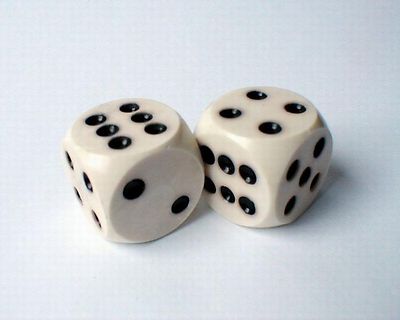
Dice

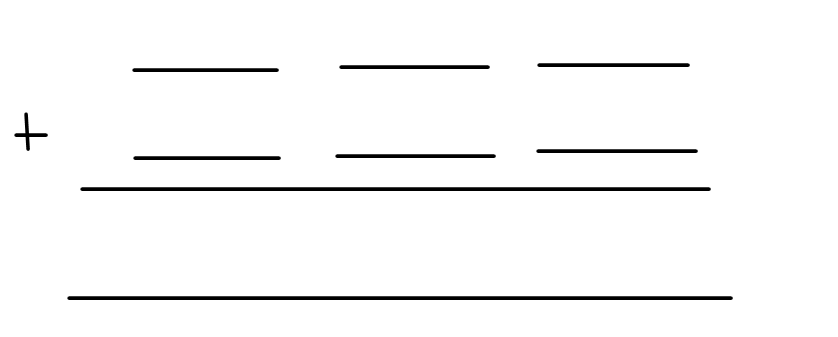
I get the children to draw some lines in the form of an addition sum (or take away, or multiply or whatever – the options are endless), leaving a space above each line to write in a number.  A bit like this:

I then use my ‘dice’ – I use the random function* in an Excel spreadsheet as my dice to generate a number from 0 to 9.  The children have to write the number above one of the lines and then my ‘dice’ generates another random number and so on, until all the lines are filled.  They then do the sum, the aim being to get the highest total (although, of course, you can vary this to change the nature of the game)

The pupil(s) with the highest score wins 5 points.  Draw a new set of lines and play again. The children will happily do all the adding, taking away, multiplying, negative number or whatever practice you want – much more exciting than just doing Page 23, Exercise 2c, questions 1 to 20

[You can, of course, just use ordinary dice to play this game, but excel is great for generating random numbers.  Here are a couple of formulas I use in an excel feild to:

  • Generate a random whole number 0 to 9: =(INT(RAND()*10))
  • Generate a random whole number from -9 to 9: =10-(INT(RAND()*19)+1)

]

Posted in Games, Numeracy | Tagged | Comments closed