Its half term, the weather is rubbish, but the Winter Olympics provide a snowy diversion from the seemingly endless rain in the southwest of England (given that we’ve been in state of flood since Christmas, it now makes sense that we do so well in the rowing sports in the summer Olympics).
Whilst scrolling through Twitter (yes – I am that old, and stuck in my ways) I came across a tweet from Japanese tweeter @shinya_workshop https://x.com/shinya_workshop who pointed out that you can trace the Olympic rings in a single brushstroke:
This got me thinking of one of my favourite puzzles – the Konigsberg Bridge problem, and I took a moment to remind myself why you can’t navigate the Konigsberg islands by crossing each bridge only once, but you can circumnavigate the Olympic logo in one go.
Don’t think of the problem as one of islands and bridges, or interconnected rings, instead think of nodes and edges, where edges are routes that connect nodes. If you are going to transverse the whole route in one go, for every node (other than the the start and finish) you must leave the node after each time you arrive at it. So every node, other than the start and finish, must have an even number edges connected to it – an out for every in – if you want to be able to visit each node without using a path already used. If you want to start and end at the same point, (ie tracing the Olympic logo in a single brushstroke) then all the nodes must have an even number of edges connected to it.
In the Kongsberg bridge problem the nodes (islands) are all odd, so no matter how hard you try, how many times you walk the walk, you will never be able to visit both sides of the river, and the two islands in the middle of the river, without crossing the at least one bridge more than once.
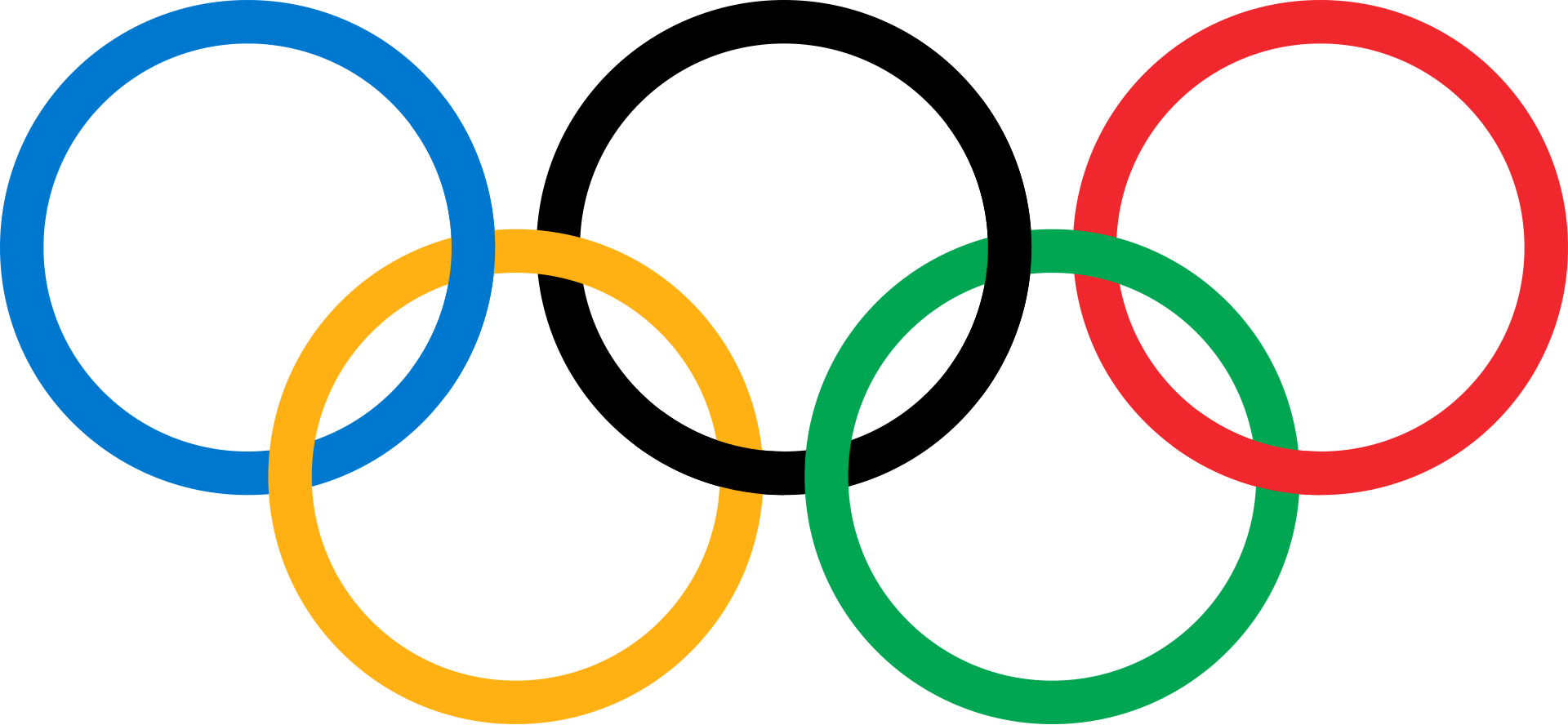
The Olympic logo, by contrast, if you consider the intersections of the rings the nodes, and the arcs connecting those intersections as the edges, you will discover that the logo has eight nodes, and each node has four edges connected to it: each node has an even number of edges so, as @shinya_workshop showed, you can trace the logo in one continuous path.
If you want to find out more about the Konigsberg bridge problem, and its solution by Euler, leading to the first steps into graph theory, Wikipedia is a good place to start.