Another Prime Day

13 11 1313th November 2013 – 13 11 13: another prime day

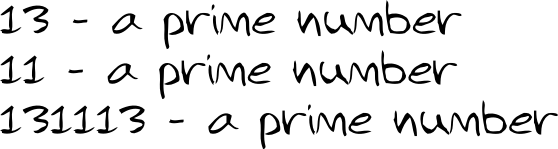
13 and 11 are prime numbers and, even better, when you put all the digits together: 131113 you get another prime number.

There’s only one more prime day like this until 2017, so enjoy it while you can!

13 11 prime numbers131113 - a prime number

Posted in dates | Tagged , | Comments closed

Palindromic, Prime and Other Dates

November 2013November is upon us, and there are a few interesting dates to look forward to:

Palindromic Dates:

The 3rd November is a palindrome: 3 11 13 The same forward as it is backwards

Prime Days:

Lots of Prime Days this month, where each element of the date is a prime number:

2 11 13

3 11 13 (A Prime Day and a Palindromic Day – Wow!)

5 11 13

7 11 13

11 11 13

13 11 13 (more of this special day later!)

17 11 13

23 11 13

29 11 13 (and this date is even more interesting – see below)

Mega Prime Days

Days where not only each element of the date is prime, but all elements combine to form a prime:

13 11 13 131113 are all prime

29 11 13 291113 (but we’re not finished with this great day yet …)

Mega Prime Plus Days

Days that are prime and mega prime days (see above), but are also prime when written in the American format: mmddyy

29 11 13 291113 and 112913 are all prime numbers

… and … 29th November 2013, 29 11 13, is the last prime day until February 2017, so you’d better enjoy it while you can!

2n + 7 Day

9 11 13


Have I missed any special dates? If so, use the comments section to let me know.

Enjoy the month!

Posted in dates | Tagged , , , , | Comments closed

Soldier’s Buttons

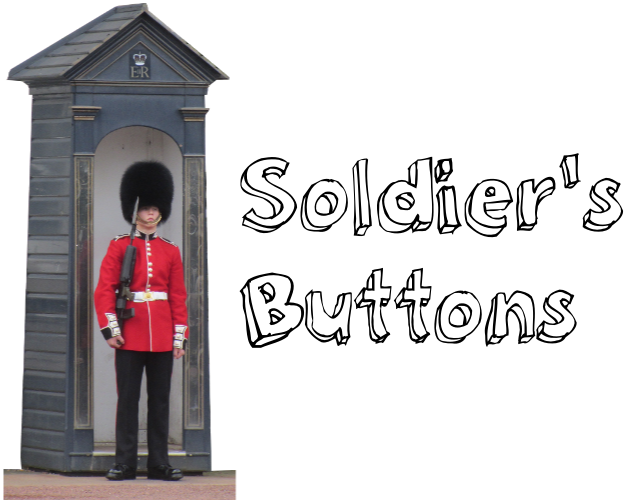
soldier's buttons - adding decimalsSoldier’s Buttons – or how to add decimals

OK – I’ll be honest, I’ve never had an original idea in my life, but I’m quite good at ripping off those that have gone before me.

Many, many years ago, at a school far, far away, I arrived as a fresh faced Head of Maths. Rummaging through the department store cupboard, I came across a dusty tome and I began to leaf through it. I found a chapter headed “Soldier’s Buttons” and I was intrigued.  It had a sketch picture of a Guardsman standing to attention and then went on to explain how, when adding or subtracting decimal numbers, you should line up the decimal points like the buttons on a soldier’s uniform.

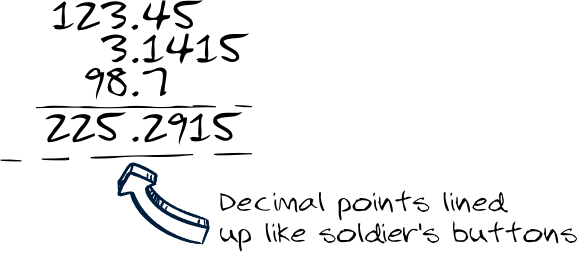
What a brilliant idea.  So I immediately pinched it and began teaching it as my own! For years I have been (very badly) drawing a picture of a Guardsman on the board and reminding pupils of: “Soldiers Buttons!” – getting them to line up the decimal points like the buttons on a soldier’s uniform before adding or taking away:

soldiers buttons - adding decimals exampleAnd I was reminded of this on a half-term day trip with my family* to London.  Seeing the Guards in front of Buckingham Palace, looking so smart, with their buttons lined up in a straight line, just like when we add (or take away) decimals …

Need to practise adding and subtracting decimals (remembering soldier’s buttons!)? Then these may be of help:

*You can read about my day trip to London on my o/h’s blog

Posted in Numeracy, Teaching Tips | Tagged , | Comments closed

Congratulations!

Doctors and nurse make a difference – on a daily basis they change lives.

Policemen and women, Firefighters – they keep us safe and secure.

Not all professions can claim that, not all jobs make the world in which we live a better place.

Teaching? Its easy to forget, but teachers open doors and let others fulfill their potential.

Watch this short video to see what it means to a father when his son, who has always struggled with the subject, gets a grade C in maths.


Posted in Uncategorized | Comments closed

Maths Product Problem

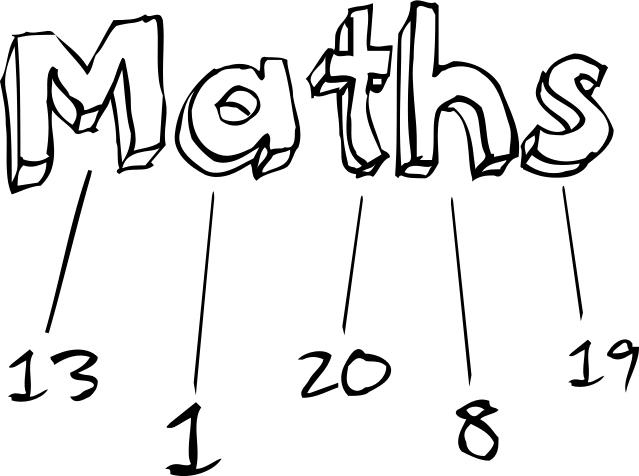
maths product problemTake the letters of the alphabet and assign them a numerical value: a = 1, b = 2, c = 3 etc. through to z = 26.

So the word maths is made from the numbers 13, 1, 20, 8 and 19 and if you multiply them together you get 39,520.

maths product puzzle

Can you find any other words that also have the product 39,520?

This is a great – if tricky – puzzle: you can just leap straight in and try and find an answer.  Or you can use a bit of maths to help you. (Think factors, think prime numbers, think what happens when you multiply by one? All of which may, or may not, help you.)

And it can be used to introduce that often tricky concept of proof: can you prove that the shortest possible word must contain at least 5 letters?

I’ve got a few answers, but I’m not going to share them with you yet. Have a think about it first – you can always give your answers, or proofs, in the comments section. I’ll provide my solutions in a later post, but for now get your thinking caps on and have a go at solving this problem.

Enjoy!

To help you with this puzzle, below is a table with the alphabet and the number assigned to them:

A

B

C

D

E

F

G

H

I

J

K

L

M

1

2

3

4

5

6

7

8

9

10

11

12

13

N

O

P

Q

R

S

T

U

V

W

X

Y

Z

14

15

16

17

18

19

20

21

22

23

24

25

26

Posted in Numeracy, Puzzles | Tagged | Comments closed