
Gove Levels Part II – The I Level

Back in September, I wrote about “Gove Levels” – the proposed changes to the exam system for 16 year olds proposed by the Secretary of State for Education, Michael Gove.

Today, we’ve heard a little more about his proposals and his latest ideas, which are being called (not officially) I-Levels. The I stands for Intermediate.

The I-Level is very much an evolution of what he came up with in September. Here are a few ‘highlights’ that we found out today:

  • Exams will be graded 1 to 8, replacing the A* to E grades.  8 is the highest mark, equivalent(ish) to an A*, although less 8’s would be awarded than A*s currently.  By having 8 as the top mark, extra levels could be added if necessary, unlike with the current system – where do you go after A*?
  • No coursework (except for a practical in Science worth 10%) with all exams being taken at the end of the school year (June), except for Maths and English, which would be taken in November. I can see this causing some timetabling problems – what do you do with pupils in the Spring and Summer term once they’ve taken and passed their maths and English exams?  Those going on to study these at AS and A Level can start their courses, but what about the rest? Perhaps this is a precursor to some compulsory studying of maths and English to post-16 level? Not sure that I see the merit in doing maths and English in November – perhaps you can come up with a reason.
  • No retakes for a year.

Using a number system could (will!) lead to a change in the way the league tables are produced – they may well be done on the total points per pupil or average points per pupil. The former would “encourage” schools to enter pupils for lots of exams, the latter to enter pupils only in those exams in which they will do well. Or, more likely, it’ll be some combination of the two – say: the average of 5 (or 6 or 8) exams, including maths and English. What is sure, though, is that whatever system is used, schools will find a way to ‘game’ the system if they are being judged using these results.  Hopefully, though, it will put a stop to the focus on the D/C candidates (getting a pupil from a D grade to a C has a huge positive impact on the school’s performance) at the expense of the top and bottom end of pupil performance (an A* is little better than a C as far as league tables go).

But despite all this – will it actually happen? Who knows. Less than 24 hours after these scant details were released, there is already argument over who released the info, and whether they should have. In February, Mr Gove seemed to backtrack on his proposed changes and a start date (to start teaching for the new exams) of September 2015 with the first exams in June 2017 is not a lot of time to get the exams properly tested and piloted.

So who knows, maybe its just more hot air, maybe its just another opportunity to bring Mr Gove to our attention, to show us that he is a politician who is doing something, a politician who maybe has designs on Number 10 …


Posted in Uncategorized | Tagged , | Comments closed

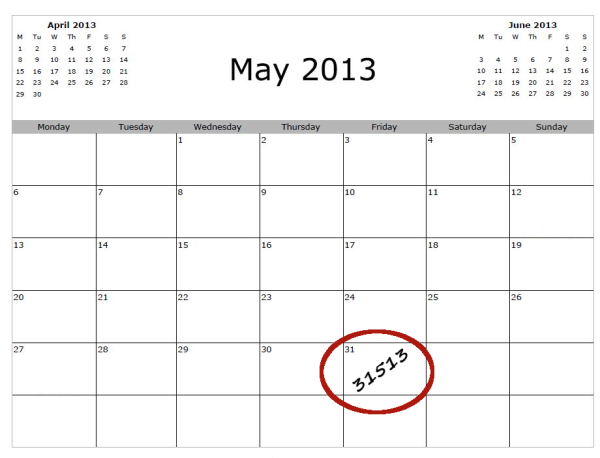
31513

31 5 13 A Prime Day and a Palindromic Date

What a special day!

The 31st May 2013, or, as we write in Europe, 31 5 13.

And this is what makes it so special:

  • Its a Palindromic Date 31 5 13 – the same forwards as it is backwards
  • Its a Prime Day 31 5 13 – all the numbers in its date are prime numbers
  • AND … 31513 is a Prime Number itself

All those three happening on the same date isn’t going to happen again for a loooooong time.

So enjoy the day, we won’t see its like again for some time (can you work out when?)

Posted in dates, Numeracy | Tagged , , | Comments closed

Revision Tip

We’re well and truly into exam season and (hopefully) lots of revision is taking place.

The best way to revise maths is to do questions – practice, practice and more practice.

But for a change, why not make some posters in the style of the “Keep Calm and Carry On” range, using short formulas, statements and other gems to remember?

Its simple to do – use the Keep Calm-o-matic  site to generate your posters. Coming up with the phrases will help fix them in your mind and you can save them as images and use them as a quick revision guide.

Here’s another one I made, to remind me to include the extra zero when doing long multiplication (although you don’t need to worry about this if you use the grid method …)

Teaching Tip

If you’ve got access to class full of computers, why not get your whole class to make their own poster, and then the results can be saved and shared by all. (And you could get added kudos by suggesting this idea to your colleagues in the staff room – a great idea for encouraging making pithy revision notes in any subject.)

Posted in Exam tips, Teaching Tips | Comments closed

Exam Top Tip!

Highlighter Pen

Highlighter Pen – an important part of any pupils maths kit

The more I teach maths – and I’ve been teaching it for a while now – the more I’ve come to realise that often its not a pupil’s mathematical ability that causes them difficulties, but the language of maths that is the problem.

So as we enter exam season, I offer this top tip for success in mathematics: buy and use a highlighter pen.

Questions are often wrapped up in words, but the words don’t matter, well most of them. Pick up your highlighter pen and highlight any numbers and a few keywords – suddenly the question becomes a whole lot clearer.

Look at this example:

Fred and Terry are building a wall. To make mortar, they need to mix sand and cement in the ratio 5 parts sand to 1 part cement. They estimate that they need a total of 30Kg of mortar. How much sand do they need?

A fairly simple question wrapped up in lots of unnecessary words. So lets take our highlighter pen and pick out the key parts to this question:

Fred and Terry are building a wall. To make mortar, they need to mix sand and cement in the ratio 5 parts sand to 1 part cement. They estimate that they need a total of 30Kg of mortar. How much sand do they need?

So a rather long question simply becomes

Ratio 5:1, total of 30

… and all you need to do now is share the 30 in the ratio 5:1 (If you want some practice in sharing in ratios, you can get some questions from my worksheets here)

It doesn’t matter that its Terry and Fred, or what they are doing, that’s all just irrelevant information. Use your highlighter to pick out the key info and ignore the rest of the question, its only there to confuse you.

Oh, and highlighters can be a great help too when simplifying equations, but that’s a whole other blog post for the future.

If you are doing exams – at any level – over the next few weeks: Good Luck!

Posted in Exam tips, Teaching Tips | Tagged | Comments closed

A Prime Day

2/5/13 A Prime DayIt’s a Prime Day today!

Today’s date 2/5/13 is made up of prime numbers.

And tomorrow (3/5/13) is a prime day too.

In fact, there’s rather a lot of prime days this month – over 13 (that’s 33.33% if you prefer working in percentages) of the days this month will be prime days.

Was yesterday (1/5/13) a Prime Day?

No it wasn’t. Wondering why? Then have a look at this which may help explain.

And, for some, the day after tomorrow is special too – Star Wars Day (May the Fourth … geddit?!)

Oh, and I’m really looking forward to the last day of the month. Why? Perhaps its because I’ll be on my hols, soaking up sunnier climes, or perhaps its because that date has two special features …

Posted in dates, Numeracy | Comments closed