A(nother) Special Day

51015 A Palindromic dateMonday 5th October – or 5 10 15 – is a special date:

Its a palindromic date: it reads the same forwards as it does backwards …

… and it is 5n day, where 5n is the formula for the nth term of the date series

5, 10, 15 …

Whatever you do on Monday, I hope you have a good day.

Posted in dates | Tagged , | Comments closed

Posters

postersThere has been a bit of a discussion on Twitter over the last few days about the importance – or otherwise – of pupils making posters. It all started with this blog post written by David Didau who you can (and should) follow on Twitter as @LearningSpy

Reading his post, it it becomes apparent that he does not look too favourably upon pupils spending valuable curriculum time making posters. I agree, and was reminded of my experience below.

A number of years ago, I taught the Year 7 daughter of a colleague, a fellow maths teacher in the same school.  She was a bright girl holding her own in an able top (ish) maths set. It was February, the days were short, the nights long and the next holiday seemed a long way away. Pupils and teachers alike were tired, snuffling and sneezing. It was the time of year that has little to commend it. And, to complete the mix, the Year 7’s were preparing for a dramatic production and many of them were involved in numerous lunchtime and after school rehearsals.  They were knackered.

Being the kind, sympathetic and empathetic teacher that I am, I recognised this and resolved to set them an easy homework (not setting a homework was, alas, not an option.  The flak that I would receive from parents and bosses was just not worth it.) And so, as the end of the lesson approached, I handed each pupil a piece of blank A4 paper and told them that the night’s homework was to make a poster on whatever it was we had been learning that day. I even gave them a quick demo on the whiteboard of what I expected (not a lot.) And so I bade them farewell, wished them good luck for their rehearsal and awaited my next class to bound through the door, warmed by the self-satisfied glow that I had done the right thing and given them a piece of homework that would take them about 5 minutes.

The following day my colleague, the parent of the girl I taught in Year 7, cornered me in the staff room.  She was very polite and very pleasant, but pointed out that a “poster” homework was the worse possible homework I could have set. Her daughter spent hours on it, forever refining and improving it (well the presentation of “it”) and she couldn’t tell when she had finished.  There were tired tears in the household that night as parents implored her to stop, but daughter was a perfectionist and was not satisfied with her work so just kept on going.

I aplologised to mum and explained my rational for setting the work (and, when I collected the homework, the evidence suggested that there were a number of students who hadn’t even spent 5 minutes on the task). She understood, we all moved on and, some days later, the production was a theatrical masterpiece.

I don’t think the pupils gained much from that homework, but I learned a lot and since that day I have never asked my students to make a poster, either in class or for homework.

Posted in Teaching Tips | Comments closed

You couldn’t make it up, could you?

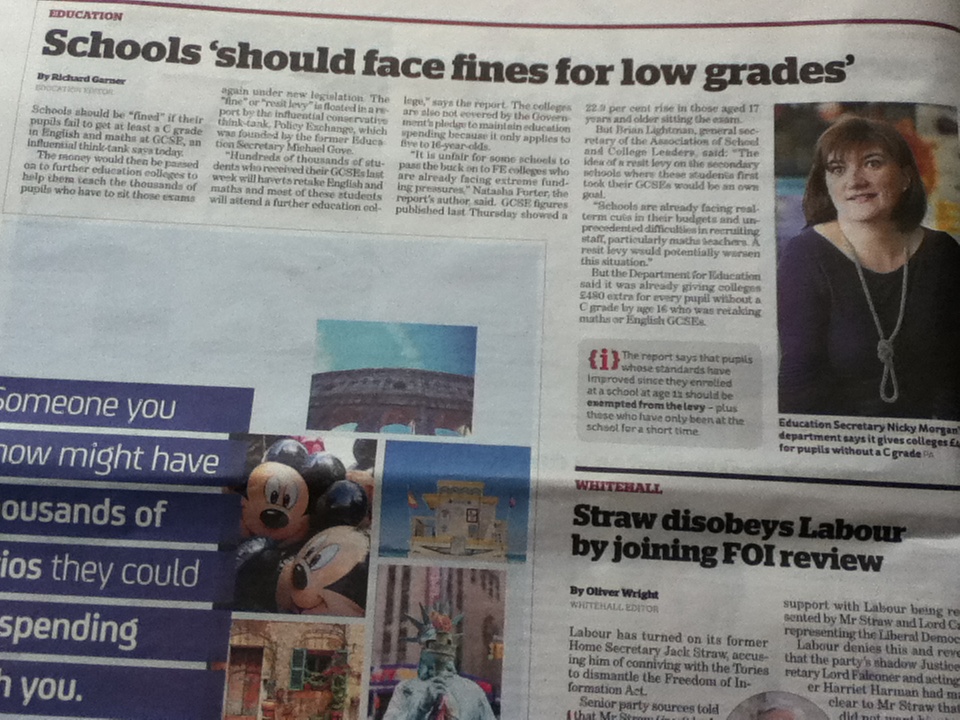
Fines for low grades

A year or so ago a group of teachers were “discussing” the “management’s” latest initiative to improve standards (for which, read results, for which read position in league table) when one teacher made one of the most profound and insightful statements about education that have heard:

They won’t improve the results by making us [teachers] work harder

I don’t know if this was his own original thought or a quote that needs to be attributed elsewhere, but it is so true. Teachers already work long hours and do what they can to get the best results possible for their charges. Just making the teachers do more (of the same?) is going to have little impact as they are already working to their full capacity. (Getting the pupils to work harder might, on the other hand, have some effect …)


And so, as my summer holiday draws to a close, I was disappointed to wake this morning to find reports across the press and media that the Policy Exchnage – a think tank originally set up by Michael Gove – are suggesting that schools should be fined £500 per pupil who fails to achieve a grade C or better in GCSE Maths or English.

Now my understanding of the purpose of a fine is to modify behaviour through the deterrence effect: as I reach a 30 mph zone I slow down because I don’t want to be done for speeding and be fined. I buy a railway ticket from an automated booth before hopping on a train as, again, I don’t want to be caught and fined if I don’t.

One gets the impression that the Policy Exchange must think that we’re not doing enough to help our students achieve the “magic C” and with the prospect of fine dangling over our heads like a modern day sword of Damocles we’ll do that bit of extra work that we are obviously not already doing and convert all the D’s, E’s and F’s into C’s.

But if they listened to the discussion I mentioned above, they’d realise that it doesn’t work like that. Alas, students are not a simple manufactured widget or a rational economic unit. Teachers and schools do genuinely do all that they can to get the best possible results for their pupils. We don’t need draconian threats to motivate us – fines will make no difference what so ever as they can’t make the schools and teachers work any harder than they already are.

I confess, in the above paragraph I told a lie. Fines will make a difference, a negative one, as they will simply suck money out of already stretched school budgets. Time for the think tank to batten down the hatches and head of back to Salisbury Plain for maneuveres.

Posted in Uncategorized | Comments closed

‘Twas the night before results day …

clever clogs

So, when I went to bed last night I was a little anxious. Why? Today is GCSE results day and as I fell asleep I wasn’t convinced that my whole class would secure that oh so important Grade C (or better.) There were (at least) 3 students of mine for whom a grade C would be a great performance and significant improvement on their January mock. I was hoping for a few B’s, and, in my wildest dreams, I would, perhaps snag an A from one of (another) 3 students who might just ace it.

And so the day dawned. I logged and and looked at “my” results.

Why did I ever doubt them? Those lovable teenagers who I have cajoled, prodded, praised and chastised in equal measure for the last two years had only gone and bloody well done it.

All got at least a C (meaning that they will now wave a little white flag of surrender and give up maths. Forever.) Most got B’s (including one of my three who I feared may end up with a D) and a couple of them got As.

Teenagers tend to get a bad press. They don’t deserve it – give them a bit of respect and you get it back in spades. I’m actually (now) looking forward to seeing them again in September as they return for the sixth form, a little bit wiser and a little bit older and no longer will I have to chase them up for their homework or convince them that algebra is far more interesting than that girl wandering past the window …

Posted in Uncategorized | Tagged | Comments closed

A Safe Bet?

A safe bet?A few days ago good pal of mine got in touch with me. I could sense his excitement, he knew he was in the money.

William Hill are offering a prize of £50 million, for a £2 stake, if you can correctly predict how the Premier League will finish.

I’m thinking to put the top 6 or 7 the same in each, as well as the bottom 4 or 5, and then varying for those in the middle, can you give me an idea how many teams I’d need to be sure of to give me some leeway in mid table?

… he asked. He figured he could predict the top and bottom of the table with some certainty, and was planning on making about 50 entries to cover the different permutations for the middle of the table, netting him a return of £50 million on his £100 investment. The generous chap that he is, I’m sure he would remember me – his adviser – when he scooped his fortune.

I had to break it to him gently. As I wrote in this post, there are a staggeringly large number of ways that the twenty teams could finish the season. But my friend is smart, and by fixing the top and the bottom of the league his chances of winning improve enormously – let’s face it, whatever happens, Chelsea aren’t going to get relegated and Bournemouth won’t win the tittle.

To keep the numbers simple, I suggested we fix the top six and the bottom four, leaving ten teams to be arranged in mid-table. How many ways of doing this are there? Alas, more than 3.5 million. (10 x 9 x 8 x … x2 x 1, or 10!) so he was unlikely to “get lucky” with one of his fifty selections.

Undeterred, he changed the question:

How many teams must I lock down to cover all combinations with my fifty choices?

Locking down 15 teams, leaving 5 to be arranged, gives rise to 120 (5x4x3x2x1 or 5!) permutations, locking down 16 teams, leaving 4 to be moved around gives rise to 24 (4x3x2x1 or 4!) different possible outcomes. The numbers are not on his side!

You won’t beat the bookies – that’s about the only safe bet I can recommend.

Posted in Handling Data, Probability | Tagged , | Comments closed