Today – The Root of All Evil!

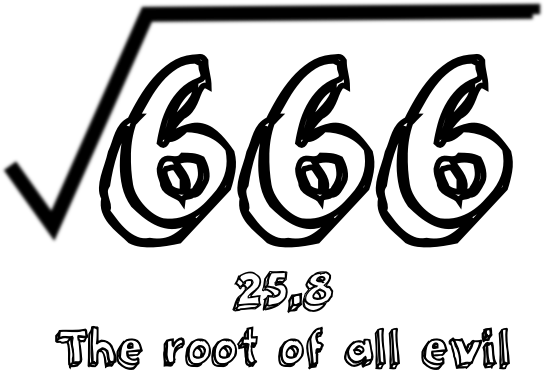
Root 666 = 25.8If 666 – the number of the beast – symbolises all that is evil, the square root of 666 must be the root of all evil.

√666 = 25.8 (to 1 decimal place) and today is the 25th of August, or 25.8

So today is the root of all evil day.

[Should you be worried? – not really, √666 is irrational, a bit like this whole theory!]

Posted in dates | Comments closed

Congratulations!

Picture courtesy of dots and spots

Picture courtesy of dots and spots

Congratulations to all of those who got the results they deserved and hoped for in yesterday’s GCSE results (and last week’s A & AS Levels) – you’ve worked hard, done your best and reaped the rewards. Well Done!


Posted in Uncategorized | Comments closed

Radians

A picture paints a thousand words

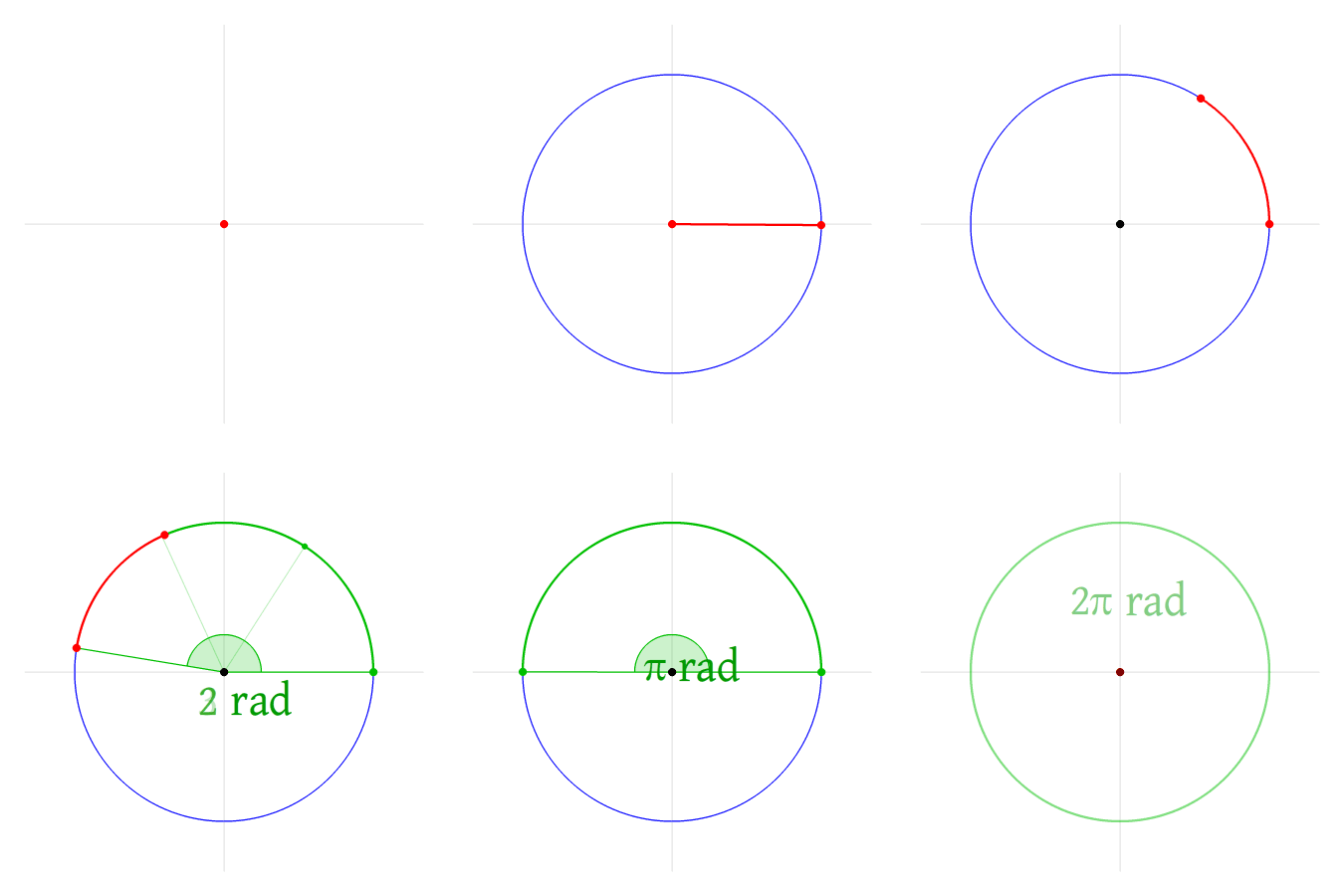
Radians animationMost people and pupils* are pretty comfortable with using degrees to measure angles. Whilst 360o might seem an arbitrary number to split a complete rotation into, it makes sense to most.

But in A-Level maths (and beyond) the humble degree doesn’t always cut it, and students are introduced to Radians, often shortened to ‘Rads’, as a means of measuring angles.

The definition of a radian goes something like this:

The radian is the standard unit of angular measure, used in many areas of mathematics. An angle’s measurement in radians is numerically equal to the length of a corresponding arc of a unit circle, so one radian is just under 57.3 degrees (when the arc length is equal to the radius).

Which is all well and good, but is a bit dry and less than illuminating.

Which is why I was so delighted to stumble across the animation at the top of this post which quickly, visually and with the minmum of fuss explains what a radian is – in this case, a picture really is worth a thousand words.

The picture isn’t mine – it was created by LucasVB, you can read his blog post about radians here and you can see the gallery of the animations he has created for Wikipedia here. A talented bloke.

I wanted to post the pic in my blog for two reasons:

  1. (Rather selfishly) I wanted a copy of the animation that I would always be able to find
  2. Its such a great explanation of Radians that I figure it deserves the widest possible audience

So, if you find yourself teaching radians, or your son or daughter asks “What’s a rad” – show them the image above and all will become clear.

*Not a very good sentence as, of course, pupils are a subset of people.

Posted in Shape and space | Tagged , , , | Comments closed

Maths Teacher Shortage!

Maths Teacher Shortgae

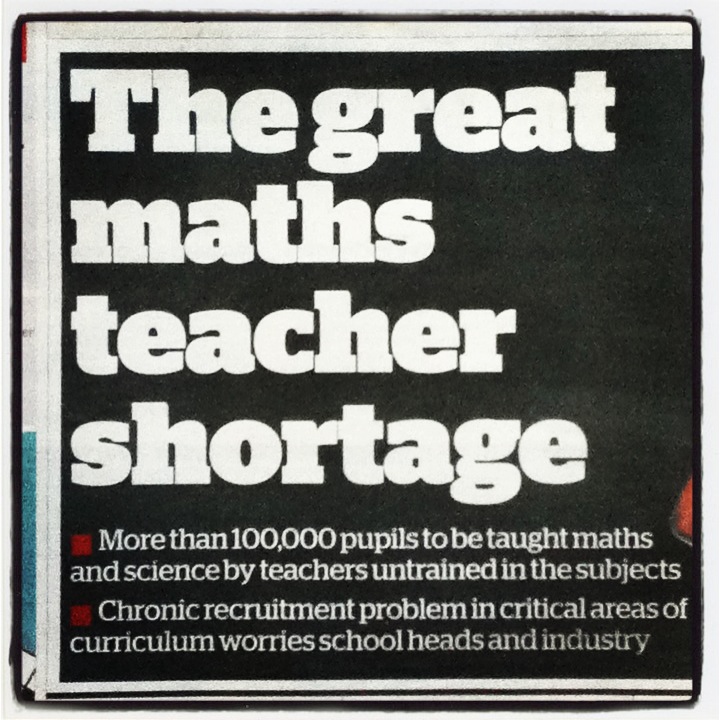
‘i’ Newspaper front page, 13th August 2013

I’m enjoying my summer hols. Today, I went for my daily swim at my local open air lido, swam my kilometer (pauses to polish halo), came home, made my lunch and settled down outside to eat it. Turning on the radio and tucking in to my first sandwich as the sun beat down on me, I looked at the front page of my paper and froze, mid-bite, as I saw the headline pictured above.

It would seem that we maths teachers are a rare species and, whilst not yet at risk of becoming extinct (which, no doubt, would delight millions of school children across the land), our numbers continue to get fewer.

30% of place on maths PGCEs (Post Graduate Certificate in Education – teacher training in plain language) have not been filled for this September, which could lead to a potential shortfall of 700 maths teachers in a year’s time. Oh dear. And this whilst we are still in the teeth of an economic downturn, a time when, traditionally, more people enter teaching as other jobs are not there.

I often joke that, come mid-July (when our long summer holiday begins), teaching is the best job in the world. (Most of the time) Teaching maths is great – if you’ve got the skills, why not join us, “we few, we happy few, we band of brothers” (thanks to the English dept. for supplying that Shakespeare quote from Henry V).

So make sure you look after your maths teachers – you don’t know where your next one will come from!

Happy hols – I’ll be swimming again tomorrow. A swimming maths teacher, now that is a rare sight!
Posted in Uncategorized | Comments closed

Log Tables

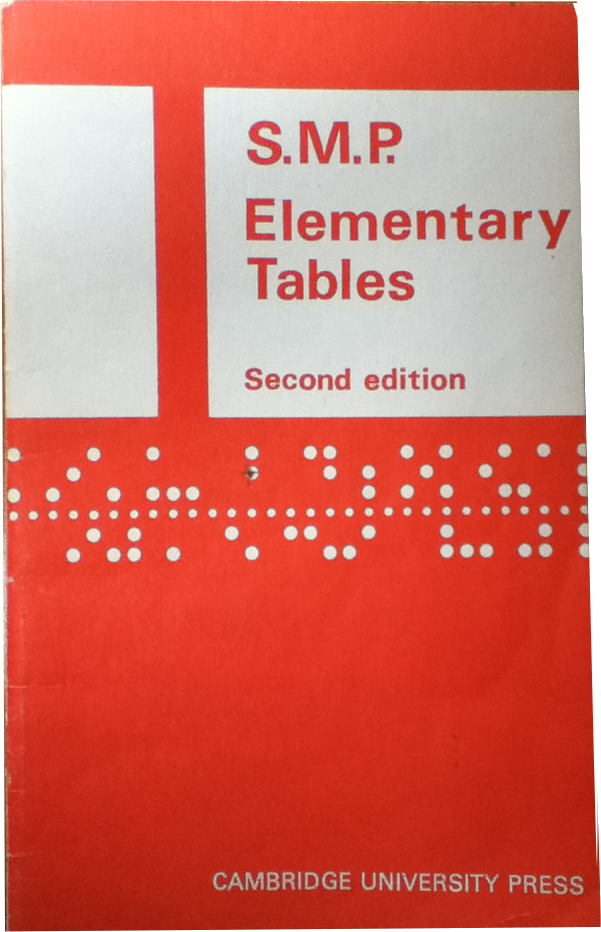
Remember these?

log tables

Whilst having a summer holiday clear out and rummaging through an old cupboard, I came across these “Log Tables” as we used to call them when I was at school ( a long, long time ago!)

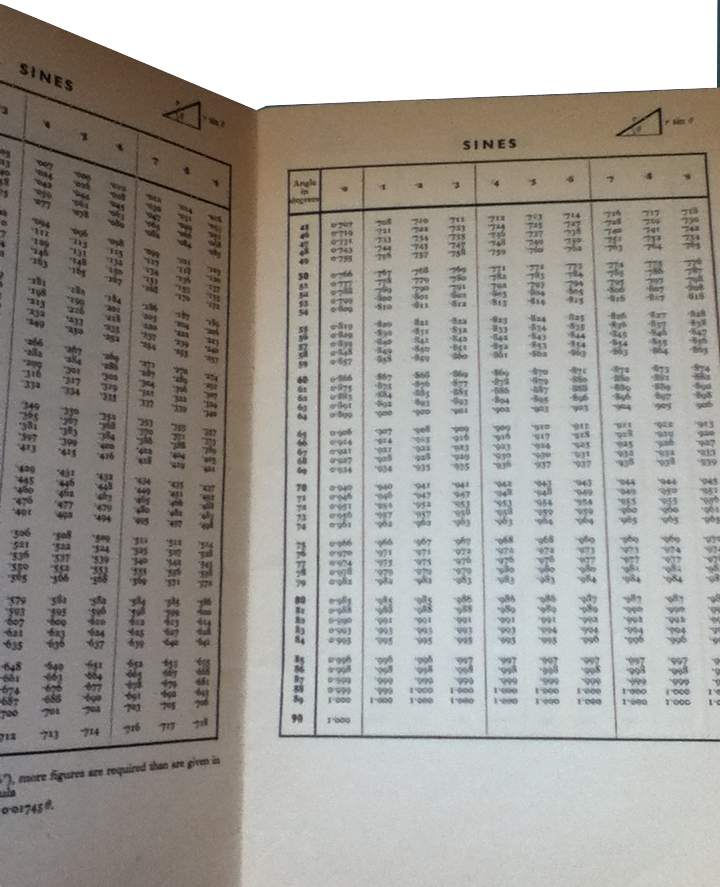
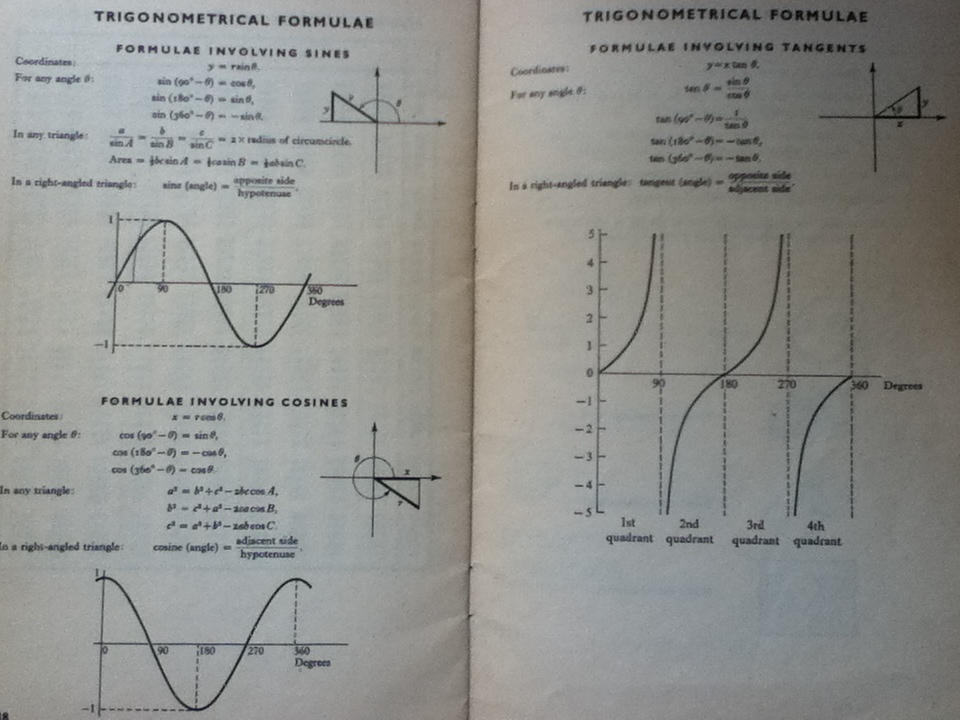
But they had so much more than just logs, they had sine, cosine and tangent tables too:

sine tables

The calculator is a brilliant tool – and I wouldn’t do without it – but leafing through the dusty pages of my old book of tables I was reminded of the fascination and mystery that these slim tomes held, with their pages of numbers and formulas and graphs. (And I should also mention the pain – one particular teacher would, as a punishment, would make you copy out a page of logs or sines or tangents.  We soon learnt that he would only check the first and last few so once you’d copied out the first line you could just make up the numbers as you went along, but it was still a pretty tedious activity.) Oh happy days!

sine, cos and tangent graphs


Posted in Uncategorized | Comments closed