Fractions

Fractions – how low can you go?

Limbo - in lego figures

Just like these limbo -ing Lego figures, I like to imagine fractions seeing how low they can go. Whenever they can, fractions should be simplified, cancelled down, put in their lowest terms … basically, make the top and bottom numbers the smallest they can be.

Remember the mantra: “Whatever you do to the top, you must do to the bottom.” To cancel down a fraction, try and find a number that divides into both the top number (the numerator) and the bottom number (the denominator).

Need some practice in cancelling down fractions? Then you could use my Equivalent Fractions Worksheet

Like all my worksheets, it can be used to generate an unlimited amount of different questions.

And there’s more fractions worksheets like:

Converting Mixed Numbers to Top Heavy Fractions

Finding Fractions of amounts

and more, to be found at my worksheets page

The worksheets work well when projected onto an interactive whiteboard for the whole class to try – the answers are hidden but can be shown by clicking the strip towards the bottom of the page.

And they’ve been optimised for printing – the questions and answers are printed on different sheets and they print out in black and white, with no extra images or ‘bumph’ on the printed page that you see on the screen, making them great for photocopying and saving you ink when you print.

With more worksheets being added all the time I hope you find my maths worksheet page a useful resource for home or school.

 

Posted in Numeracy | Tagged , | Comments closed

socks

socks on a line

Mr. Mobius is a maths teacher. A very good maths teacher. A very good maths teacher who likes colourful socks.

But he does have some rather, shall we say, odd ways.

When he hangs out his colourful socks to dry he likes them to be hung on the line in a certain way.

Not for Mr. Mobius a neat collection of ordered pairs.

No. When Mr. Mobius hangs his three pairs of socks out to dry (one blue pair, one red pair and one green pair) he likes them to be arranged on the line in a certain way.

He likes, no, insists, that there is one sock between each blue sock, two socks between each green sock and three socks between the red socks.

Can you arrange three pairs of socks to satisfy the laundry requirements of our favourite maths teacher?

Why not get some socks and try yourself (or, better still, get some socks, pegs, a washing line and a child and encourage them to solve the ‘sock problem’.) Maths isn’t just sums on paper!

Posted in Numeracy, Puzzles, Teaching Tips | Tagged | Comments closed

Count Quick!

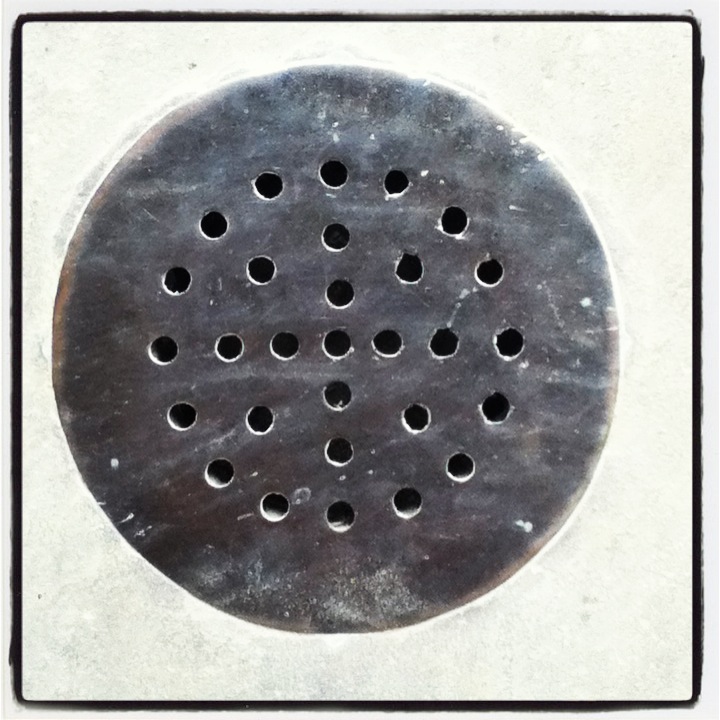
drain coverHow many holes can you count?

I came across this circular drain cover and I liked it – I liked its symmetry and its circular nature.

I decided to count the holes, and challenged those with me to do the same – a sort of maths race!

We all got the same answer (no – I’m not going to tell you, count ’em yourself!) but we used a variety of different strategies.

Me – I saw a cross or plus sign + in the middle, and worked from there. Others split the shape into quarters, some saw groups of three …

Whilst there is normally only one ‘right’ answer in maths, there is often more than one way to get there.

Amazing how much fun can be had from a simple drain cover!

(Got your answer yet?)

Posted in Numeracy, Quick Count | Comments closed

Approximate Pi Day

Approximate Pi DayHappy Approximate Pi Day!

22nd July – 22/7 A reasonable approximation for Pi – good to 2 decimal places.

If you want a better approximation for Pi you could use 333/106 which is good to 4 decimal places, or, for even more accuracy, use 355/113 which is good to 6 decimal places.

But you can’t write Pi as an exact fraction as it is an irrational number.

Irrational numbers are real numbers that can’t be written as an exact fraction. It has never ending, never repeating numbers to the right of the decimal point.

22/7 – Approximate Pi Day – Enjoy!

Posted in dates, Numeracy | Tagged | Comments closed

17713

17 7 13 - 17th July 13, a Prime DayWednesday 17th July 2013 – another prime day!

17713 is prime as are all the individual components: 17, 7, 13

And it works in America too!

7 17 13Writing the month, day, year still yields a prime number 71713

It’s the last UK Prime Day until November (America get another prime day on 23 July – 72313)

(note: I’m publishing this blog post on Tuesday 16th July so you find out about it before the day itself!)

Posted in dates | Tagged | Comments closed